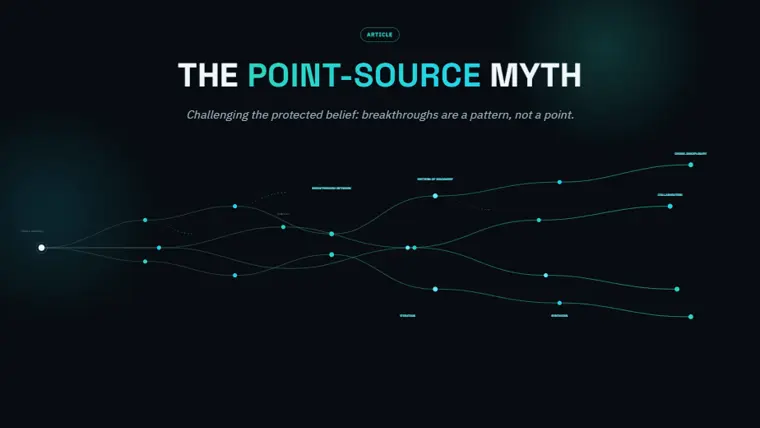
Who Draws the Lines?
If breakthroughs are already distributed, the organisation stops being the unit of innovation. Something else takes its place.
In 1714, the British Parliament faced the hardest technical problem of its age. Ships could not determine their longitude at sea, and the ocean floor was collecting the wreckage. The obvious move was to hand the problem to the finest minds available - the Astronomer Royal, the Royal Society, the universities. Britain had the deepest scientific bench in the world.
Instead, Parliament did something stranger. It published the problem. The Longitude Act posted a prize of twenty thousand pounds - several million in today's money - and opened the question to anyone.
The answer did not come from the bench. It came from John Harrison, a self-taught clockmaker, the son of a carpenter, who spent decades building a timepiece accurate enough to carry Greenwich time across an ocean. The scientific establishment was so committed to its own approach, an astronomical method, that the board withheld his reward for years. The outsider had drawn a line between two stars - precision horology and navigation, that the experts, standing inside their own brightly lit room, could not see.
I ended my last piece with a question that incited several interesting followups: if the breakthrough is already out there, distributed across people who have never met, what exactly is your organisation for?
Here is the answer I keep arriving at, and I will be honest, I do not entirely like it. The organisation is no longer the unit of innovation. It is a node. And the moment you accept that, a different question takes over — not how to make the node brighter, but who draws the lines between nodes. That question has an answer too, and it rearranges what leadership means.
The problem outgrew the org chart
Start with why this is happening now, because it is not a fashion.
A hierarchy is a machine for executing the known. It compresses information upward and decisions downward, and when the problem is stable and the playbook exists, nothing beats it. I have run hierarchies and I have defended them; they are unfairly maligned by people who have never had to deliver anything at scale.
But watch what has happened to the problems. Energy transition is simultaneously an engineering problem, a market-design problem, a financing problem, a community-consent problem and a geopolitical one. The same is true of supply-chain sovereignty, of AI governance, of the health workforce. These problems do not respect the boundaries our institutions were drawn along. No single org chart contains enough of the relevant sky, and no amount of internal excellence changes that, because the missing knowledge is not below standard inside the building — it is absent, held by someone in a different building entirely.
Hierarchies are how you scale an answer. Networks are how you find one. Most of our institutions are magnificently equipped for a kind of problem we have progressively less of.
Communities remember
The usual response is transactional: hire the consultancy, attend the conference, commission the study. Buy the missing knowledge by the hour.
The trouble is that transactions do not compound. The engagement ends and the knowledge leaves in a slide deck that nobody opens twice. The conference is a one-night stand between ideas; everyone returns home unchanged. Each transaction starts from zero because nothing holds the memory between them.
A genuine community is a different kind of object, and the difference is compounding. When a working community solves a problem - really works it, argues it through, writes down what held - the solution does not evaporate. It raises the floor for the next person who arrives with a cousin of that problem. Patterns accumulate across cases the way interest accumulates on capital, and like interest, the curve is unimpressive for a long time and then suddenly is not.
Organisations most often forget. It is one of the most reliable things about them; restructures, departures and rebrands wipe the tape with astonishing efficiency. on the other hand, Communities remember, when they are built to.
If you want proof this works at civilisational scale, you are reading this on it. Open-source software is a community of strangers, spread across thousands of rival organisations, whose contested, accumulated fixes now run most of the world's computing. No single company could have built it. Every single company depends on it. That is what compounding knowledge held in common looks like after thirty years.
The navigator premium
Now the uncomfortable part: value in these connected systems does not distribute evenly, and it does not concentrate where the point-source myth says it should.
Go back to the constellation. The stars got the mythology. The navigators got home. The disproportionate value was never in being the brightest light; it was in knowing which lights, drawn together, made the ocean crossable. (And yes, I wrote this with Nolan's Odyssey hangover, so pardon the references).
Every functioning ecosystem I have seen has a small number of people or institutions doing this quietly: the ones who know that the problem stalling one sector was half-solved in another last year, who can put the right five people in a room and be trusted by all five, who convert a scatter of capability into something navigable. Sociologists have a name for where these people stand - structural holes, the gaps between clusters that someone must bridge - and the research finding is blunt: the returns to standing there are outsized.
We can see the loud version of this everywhere. The most valuable companies of the past two decades own remarkably little of what they coordinate; they are orchestration businesses wearing technology costumes. But the quiet version matters more and gets no press: the convener, the translator between domains, the person whose network is not a contact list but a working map of who knows what. Orchestration is a discipline, not a personality trait, and almost nobody's job description contains it. We fund star-making - R&D, talent programs, capability builds and treat line-drawing as something that happens by accident at drinks.
That is a market inefficiency, and like all market inefficiencies, it will not last. The navigator premium is already being collected. The only question is by whom.
The arithmetic of connection
Strip the romance off and what remains is arithmetic.
An excellent organisation working alone explores the possibility space its own vantage can see - one sector's assumptions, one discipline's methods, one institutional memory. A set of merely good organisations, genuinely connected, explores the combinations. And combinations is where the mathematics turns brutal: the value of connection grows with complexity, because the more domains a problem spans, the smaller the fraction of it any single vantage covers.
This is why isolated excellence keeps losing to connected competence in every field where problems have grown entangled - and why it feels so unjust to the excellent. They did everything right by the old physics. Isolated excellence is still excellence. It is just no longer enough.
Follow the chain honestly and you arrive somewhere specific. If no organisation sees enough sky, and transactions do not compound, and the returns concentrate with whoever makes the sky legible - then the deliberate building of communities is not a cultural nicety or a marketing exercise. It is infrastructure. As material as the port, the grid, the rail line. A standing commons where different vantages meet, argue in good faith, and leave a written trace - that is not the soft stuff around the real work. Increasingly, it is the mechanism by which the real work becomes possible at all.
Almost no one budgets for it. We have R&D lines, capex lines, transformation lines - and nothing for convening, which may be the highest-return line item nobody has created yet. The few leaders I know who have understood this are not talking about it much. They are quietly becoming architects of shared sky, and in ten years I suspect their advantage will look obvious in retrospect, the way platform advantages look obvious now.
A question of role
Last time the question was organisational. This one is personal, and I ask it without a framework to sell you, because I still do not trust frameworks that arrive before the way of seeing has settled.
The constellations around your industry are forming right now, whether or not anyone in your building is paying attention. Capability is scattering across startups, research groups, adjacent sectors, rival firms, government programs. Someone will draw the lines. The history is unsentimental about this: it will not necessarily be the incumbent, the expert, or the brightest star. It will be whoever has the vantage, the trust, and the nerve.
So, in the sky that is assembling around your world: are you a star, a line, or the one drawing them?
In the end, innovation ecosystems for future won't be defined by the ideas they include. They'll need to be defined by the lines they choose to draw and who had the authority to draw them.