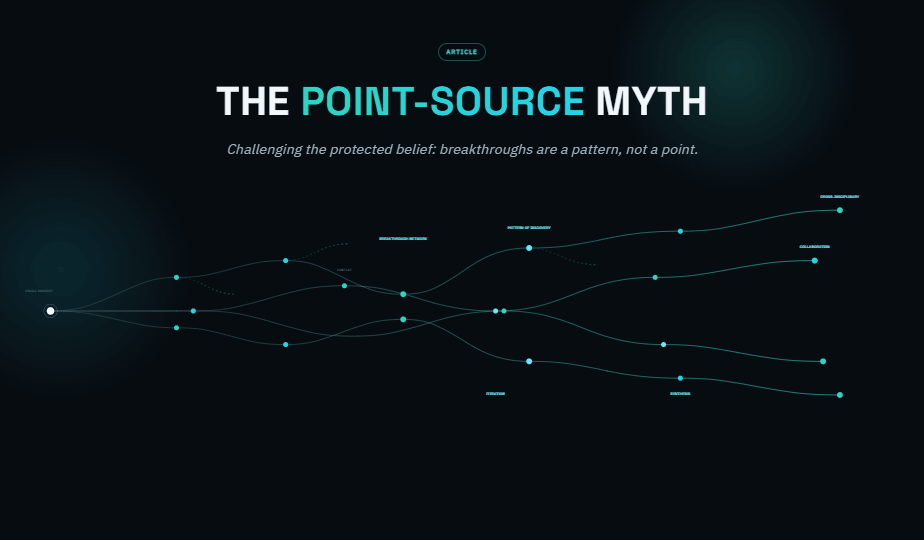
The Point-Source Myth
We built our organisations to catch lightning. Innovation was never lightning.
On the same February day in 1876, two men filed paperwork for the telephone at the same patent office, hours apart. One was Alexander Graham Bell. The other was Elisha Gray, and unless you have a particular interest in patent law, you have probably never heard of him.
Now whenever we tell that story at all, we more than often tell it as a cautionary tale about paperwork. Move fast. File first. I think that's the wrong lesson, and I suspect we chose the wrong lesson deliberately, because the right one might be a tad uncomfortable: the telephone was going to happen that year whether Bell existed or not. The components were lying around. The telegraph had normalised the idea of signals down a wire. Acoustics had matured. The electromagnet was decades old. The pieces were on the table, and two people, independently, reached for the same connection in the same week.
Historians of science have a name for this: multiple discovery. Calculus arrived twice, through Newton and Leibniz, who spent years accusing each other of theft. Oxygen was isolated separately by Scheele and Priestley. Darwin sat on natural selection for the better part of two decades until Alfred Russel Wallace, working with fever in the Malay Archipelago, mailed him what was essentially his own theory. Once you notice the pattern, you just cannot stop noticing it - very little that mattered was invented once.
And yet almost everything about how we organise for innovation assumes the opposite.
The myth we organised around
Call it the point-source myth: the belief that innovation originates at a point - as a spark, a flash point idea; from a genius, a lab, a garage — and then radiates outward like light from a lamp. It is a flattering story. It gives us someone to celebrate and somewhere to look.
It is also the physics on which we have built everything else. Budgets fund sparks. Patents fence points. Awards decorate individuals. We construct designated rooms - labs, hubs, incubators — where lightning is scheduled between nine and five. I have sat in steering committees that talked, without irony, about "where ideas come from," as though ideas had a postcode.
I believed all of this for years, and I want to be honest about that rather than write as a convert sneering at his old religion. It took a long time in and around large transformation programs to admit something simple: I had never actually seen it happen. Not once. Every breakthrough I have closely researched about, when I traced it honestly, dissolved into a network. A half-idea from one team. A constraint from a regulator that forced a rethink. A tool built for an entirely different purpose. A founder, I know too well, who happened to have stood in two worlds and noticed they rhymed. The spark story got written afterwards, for the awards night.
If your model of innovation cannot survive contact with how any actual innovation happened, the model is the problem.
The sky was never the point
There is a better model, and it has been hanging over our heads the whole time.
A constellation is a strange object when you examine it. The stars of Orion have almost nothing to do with each other. They are hundreds of light-years apart, different ages, different fates, drifting in different directions. The pattern is not in the sky. The pattern lives in the observer. Sailors drew Orion because they needed to get home, and a scatter of unrelated lights became an instrument the moment someone drew lines between them for a purpose.
Nobody owns Orion. Nobody invented the stars in it. Yet for three thousand years it has taken people across oceans.
That is much closer to how innovation actually works. The stars already exist: capabilities, half-finished ideas, unmet needs, technologies misapplied in interesting ways, failures that taught someone something. They are burning right now, scattered across people who have never met, in companies and disciplines that do not talk to each other. The breakthrough is not the ignition of a new light. The breakthrough is the line.
We fund stars and pray for constellations.
Seeing between things
If the value is in the lines, the scarce skill is seeing them, and here I part company with most innovation advice, which is overwhelmingly about training people to have ideas. Ideas are the abundant input. What is rare is the eye for relationships.
That eye has a name, and it is an unfashionable one: systems thinking. Peter Senge was writing about it before many of today's chief digital officers had started their careers, and it still has not really made it into the innovation conversation, which prefers sparks. The discipline is unglamorous. It asks you to stare at the space between things — at flows, feedbacks and dependencies — when everything in your training points you at the things themselves.
In one asset-heavy business I worked with, the intervention that changed the economics of a whole operation involved no new technology whatsoever. Someone noticed that the maintenance backlog and the rostering system were describing the same underlying problem from opposite ends. Two dashboards, watched by two departments, for years. Nobody had been paid to look between them. The moment someone did, the fix was almost embarrassingly simple, and it was worth more than the entire formal innovation program running that year.
That is what a line looks like up close. And it suggests a redescription of a familiar villain: silos are light pollution. Stand inside a brightly lit room and you cannot see faint stars. Most organisations are lit in exactly this way, brilliantly illuminated within each function, blind to everything between.
No one sees enough sky
Systems thinking gets you halfway. The second enabler follows from a hard limit: no single vantage point sees enough stars.
You can only draw lines between lights you can see, and a career shows you a narrow patch of sky. One sector's assumptions, one discipline's methods, one company's folklore. This is why the lines are so often drawn by boundary-crossers - the engineer who moved into health sector, the logistics person who wandered into solving for energy transition, the data scientist who spent months embedded with operators. They are not smarter. They can simply see two patches at once.
The corrective is not to hire mythical polymaths. It is community. I mean the real kind, and the distinction matters. Most professional gatherings are transactional: cards, pitches, pleasant agreement, nothing changed. A working community is different in one specific way - it argues. Margaret Heffernan has spent years demonstrating that good thinking requires conflict, that the most valuable colleague is the one prepared to tell you what you have got wrong. Two people looking at the same stars will see different pictures, and the honest argument between them is the drawing instrument itself. Consensus produces the constellation everyone already knew. Friction produces the new one.
Ideas do not network. People who disagree do. This has become a core philosophy for the way I see things in the ecosystem of Innovation.
Put those two enablers together - the trained eye for relationships, and a community of vantage points willing to contest each other's patterns, and you have something no lab or lone genius can replicate: a standing capability for seeing what no individual member can see. Each person contributes a patch of sky. The argument draws the lines.
What this changes
If any of this is right, the leader's job changes quietly and quite radically. Less prospecting for sparks. More tending shared sky.
The questions change too. Not "how do we generate more ideas?" but: who can see our stars, and whose stars can we see? Where does our structure make line-drawing impossible - which two dashboards has nobody been paid to look between? When did we last put people who fundamentally disagree in a room with a real problem and enough trust to have it out?
I am deliberately not offering a framework. I am suspicious of frameworks arriving too early; they are how genuinely new ways of seeing get flattened into workshops. This is a way of seeing first, and it takes a while to settle in. It did for me.
But sit with the implication for a moment, because it is the part I keep returning to. The next breakthrough in your industry very likely already exists - scattered, unconnected, distributed across a dozen people who have never met and may never meet. The stars are lit. What is missing is the line, and someone with the vantage and the nerve to draw it.
Which leaves a question I genuinely do not have a complete answer to, and I mean it as an open one rather than a rhetorical flourish:
If the breakthrough is already out there, distributed - what, exactly, is your organisation for?
I would like to hear how that lands. Especially from those who think I have drawn the wrong constellation entirely.
Consider this the opening chapter. I'll be exploring this idea from multiple angles in the weeks ahead. Watch this space.